
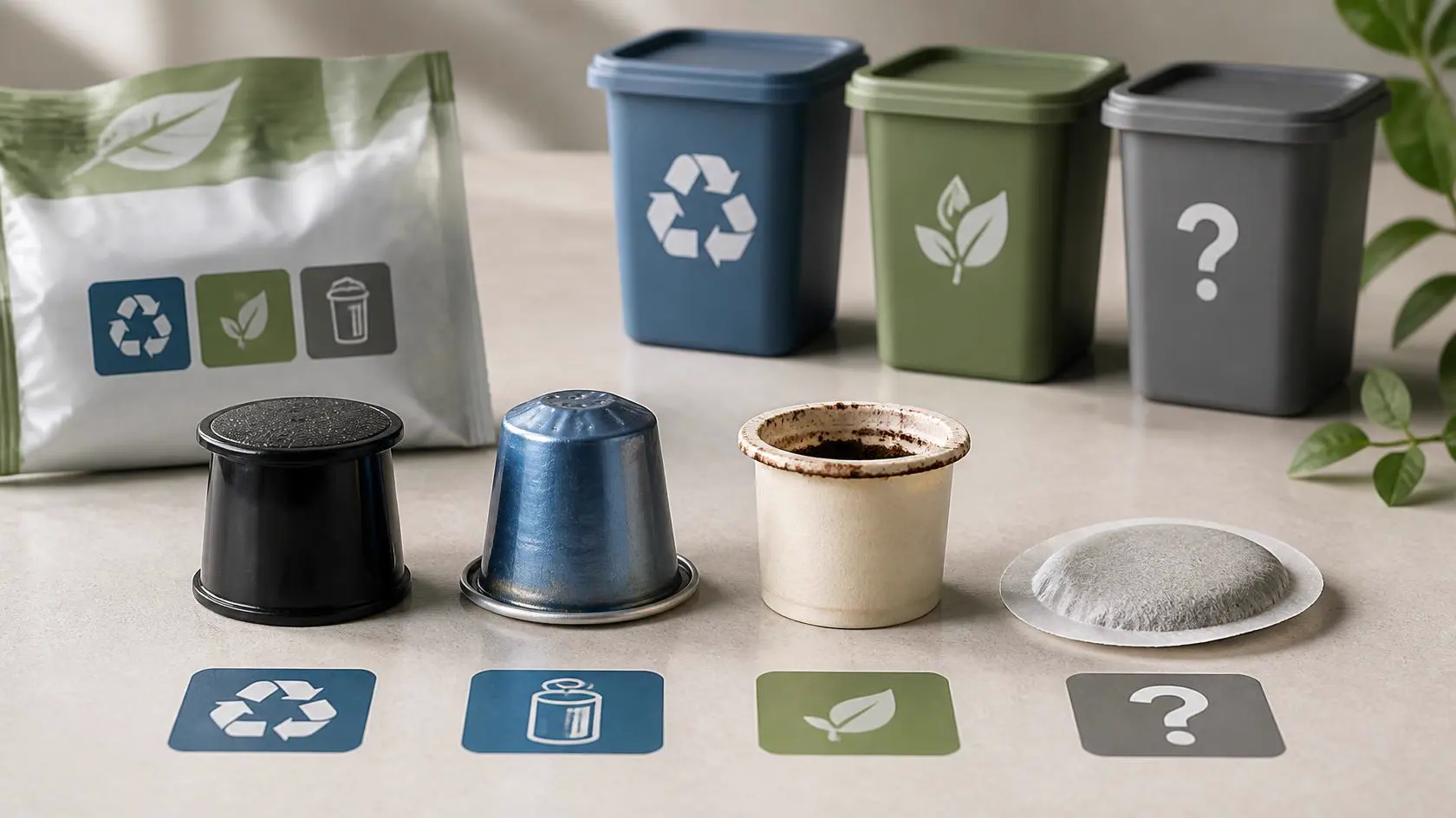

Starting August 12, 2026, the European classification of single-serve coffee capsules and pods will change. With the implementation of the new Packaging Regulation, known as the PPWR, these products are expressly considered packaging even when they are disposed of along with the coffee grounds.
This does not mean, however, that all capsules must automatically be disposed of in the same container. Disposal will continue to depend on the material, certifications, instructions on the packaging, and the rules adopted by the municipality or local waste management operator.
What is the PPWR, and why does it take effect on August 12, 2026?
The PPWR is Regulation (EU) 2025/40 on packaging and packaging waste. It establishes common rules across the European Union to reduce waste, improve the recyclability of packaging, and provide clearer information to consumers.
The regulation entered into force on February 11, 2025, but becomes generally applicable on August 12, 2026. The two dates are not equivalent: entry into force indicates that the regulation formally exists, while applicability refers to the date on which its provisions take effect.
For example, capsules and pods are included in the new European definition of packaging as of the implementation of the PPWR. Other requirements, such as certain harmonized rules on labeling and recyclability, will instead be subject to later deadlines.
Why are capsules and pods considered packaging?
In the past, it could be difficult to classify a capsule as packaging because its casing is used and discarded along with the product it contains. The PPWR resolves this ambiguity by expressly including single-dose units intended for use in a machine.
The definition includes both non-permeable units, such as hard capsules, and permeable ones, such as soft pods containing coffee. The presence of spent grounds therefore does not prevent the container from being classified as packaging.
A used capsule, for example, is still considered packaging even if it contains wet coffee grounds. However, this classification alone does not determine which household waste bin it should be disposed of in.
In fact, just because something is packaging doesn’t automatically mean it can be recycled through any collection system. It’s also important to consider the material, the way the capsule is constructed, and the capacity of local facilities to sort and process it.
What Will Actually Change for Consumers?
Starting August 12, 2026, capsules and pods will be fully subject to the European regulatory framework governing packaging. The change primarily concerns their classification, manufacturers’ obligations, and the future organization of collection and recycling systems.
However, there is no universal rule that applies to every capsule and every municipality. Before choosing a container, it is still necessary to identify the material and read the recycling instructions.
Two capsules, both considered packaging, may have different disposal routes. A certified compostable capsule may be placed in the organic waste stream, while an aluminum capsule may be collected as metal waste or through a dedicated service.
It is therefore incorrect to conclude that, as of August 12, all capsules must be disposed of in the plastic, metal, or food waste bins. The new classification does not eliminate the differences between materials and does not automatically supersede local regulations.
Do you need to empty the coffee out of the capsules?
The PPWR also considers capsules intended to be disposed of along with their contents to be packaging. This clarification pertains to their legal classification but does not establish a general rule that every capsule can be disposed of full in the recycling bin.
The disposal of used coffee should be determined based on the type of capsule and the instructions provided by the collection system. If the capsule is easy to open, separating the grounds can still help ensure proper disposal.
In general:
- Certified compostable capsules may be disposed of with the food waste along with the coffee;
- For plastic and aluminum, you need to check whether the service provider requires that the container be completely emptied;
- It is not normally necessary to wash the packaging thoroughly, unless otherwise specified;
- Certain dedicated programs may accept capsules in different ways.
For example, CIAL’s general guidelines state that aluminum packaging should be thoroughly emptied, but not necessarily washed. A service specifically set up to collect capsules, on the other hand, might provide its own instructions.
Where to Dispose of Plastic Capsules
A capsule made primarily of plastic should not automatically be placed in the plastic packaging bin. Its small size, the presence of different components, and the residual coffee can affect the ability to sort and recycle it.
You should check the environmental label and the instructions provided by your local waste management authority. If the packaging indicates that it should be disposed of with plastic and your municipality accepts this type of waste, the capsule can be disposed of in that stream, after removing any residue as required.
If there are no clear instructions or if the local service does not accept the capsules, do not assume their proper disposal based solely on the appearance of the packaging. In that case, check the operator’s website or use any designated collection points.
Where to Dispose of Aluminum Capsules
Aluminum is a recyclable material, but this does not guarantee that every municipal system will be able to recover the capsules through regular household collection. Disposal procedures may vary depending on how metals are collected in your area.
Some municipalities accept the capsules along with metal packaging; others have designated collection points or programs. Before disposal, you should also check whether the lid or other components need to be separated.
A capsule accepted for metal recycling should be thoroughly emptied when required. However, there is no need to use water to wash it thoroughly, unless the operator provides different instructions.
Compostable capsules: When Can They Be Disposed of as Organic Waste?
Compostable capsules follow a different approach than those made of conventional plastic or aluminum. They can be disposed of with organic waste only when their compostability is certified and the local system allows for their disposal.
The word “biodegradable” alone is not enough. A biodegradable material can decompose under certain conditions, while a compostable material must meet specific requirements regarding the time, conditions, and quality of the resulting compost.
You should therefore check the packaging for:
- the compostability declaration;
- a recognizable certification mark;
- a reference to the applicable technical standard, such as EN 13432;
- the explicit instructions for organic waste collection.
An industrially compostable capsule is not necessarily suitable for a home compost bin. If the label indicates that it is organic and the local waste management provider accepts this type of packaging, it can generally be disposed of along with coffee grounds.
Where to Dispose of ESE Coffee Pods
ESE pods are soft, porous units, typically wrapped in filter material. However, their resemblance to paper does not mean that all of them are compostable or suitable for organic waste disposal.
You should check the ingredients, certification, and instructions on the packaging. A pod that is specifically certified as compostable and approved by the waste management provider can be disposed of with the organic waste along with the coffee grounds.
The PPWR also stipulates that, as of February 12, 2028, permeable units containing coffee, tea, or other beverages must be compatible with composting under industrially controlled conditions. This deadline applies to the soft pods covered by the regulation; it does not automatically make all hard capsules compostable.
How to Choose the Right Container
To avoid mistakes, it’s best to follow a simple procedure. The visible information is only the first clue: the label and local regulations remain the primary sources of guidance.
Before disposing of a capsule or pod:
- distinguish between a hard capsule and a soft, permeable pod;
- Identify the material listed on the package;
- Read the environmental label and the disposal instructions;
- check for any compostability certification;
- Check the website of the municipality or the waste collection provider;
- Remove the coffee grounds when prompted.
For example, a capsule labeled “compostable,” with verifiable certification and the notation “organic waste collection,” may be disposed of with organic waste if the local service accepts this type of item. A green-colored wrapper alone, however, does not indicate any technical characteristics.
What Requirements Will Take Effect After 2026?
August 12, 2026, is not the only deadline under the PPWR. The regulation establishes a phased approach, under which certain requirements must still be finalized through technical acts adopted by the European Commission.
The key dates for consumers are:
- August 12, 2026: General implementation of the PPWR and new classification of capsules and pods as packaging;
- February 12, 2028: Requirement for industrial compostability for the permeable items specified in the regulation;
- Starting in 2028 or the next scheduled deadline: gradual introduction of the harmonized European label for materials;
- Starting in 2030: gradual implementation of design criteria for recycling;
- Starting in 2035: assessment of recyclability, including in relation to actual large-scale recycling.
Subsequent dates may depend on the adoption of the necessary European legislation. They should therefore not be presented as obligations that will already be fully in effect in August 2026.
Summary Table
| Type | Material or structure | What to Check | Used coffee grounds | General Information | Local Rules |
|---|---|---|---|---|---|
| Rigid plastic capsule | Plastic or multiple components | Environmental Label | Remove it if requested | Plastic only if specified and accepted | Always check |
| Rigid aluminum capsule | Aluminum and any detachable parts | Symbols for available materials and services | Usually well emptied | Metals or Specialized Collection | Always check |
| Compostable capsule | Compostable bioplastic | Certification, Standards, and the “Organic” Label | It can generally remain | Staff, if applicable | Always check |
| Compostable ESE pod | Soft, breathable material | Certification and Instructions | It can stay in the wafer | Staff, if applicable | Always check |
| Waffle with no instructions | Unidentified Structure | Ingredients and Label | Follow the instructions | Don’t assume it’s compostable | Essential Verification |
Frequently asked questions
Starting August 12, 2026, do all capsules have to be placed in the recycling bin?
No. As of this date, they are considered packaging, but the appropriate container depends on the material, the instructions on the label, and the local collection system.
Do you need to empty the coffee out of the capsules?
There is no single answer. Compostable capsules accepted in the organic waste stream can generally be disposed of with the residue still inside, while for plastic and aluminum, the waste management provider may require that they be thoroughly emptied.
Where do you throw away plastic capsules?
Plastic packaging should be placed in the plastic collection only when required by the label and local regulations. Alternatively, dedicated collection bins may be available.
Where do you throw away aluminum capsules?
They can be disposed of with metals in municipalities that accept them or at designated collection points. Please check with your local waste management authority.
Can compostable capsules be put in the organic waste bin?
Yes, when they are certified as compostable, they are labeled for organic waste and are accepted by the local waste management system. “Biodegradable” alone is not enough.
Where do you dispose of ESE coffee pods?
Certified compostable coffee pods can be disposed of with organic waste if the municipality allows it. In the absence of certification or clear instructions, you should not assume that the filter material is compostable.
Do “biodegradable” and “compostable” mean the same thing?
No. “Biodegradable” describes a general ability to degrade; “compostable” indicates compliance with verifiable technical requirements under specific conditions.
Will the new European labels be mandatory as early as August 12, 2026?
Not in general. The PPWR provides for a harmonized system, but its implementation depends on the European technical regulations and the subsequent deadlines set forth in the regulation.

